Showing posts with label women. Show all posts

Friday, March 25, 2011

Triangle Shirtwaist Factory Fire: March 25, 1911-2011

Today is the 100th anniversary of the Triangle Shirtwaist factory fire. On March 25, 1911, 146 garment workers in New York City were killed in a workplace fire. Infamously, management had locked the factory's exit doors. A wave of safety reform legislation and memorialization followed. For a moment, the dangerous realities that faced some of the nation's most marginalized industrial workers -- young, female, immigrants from Eastern and Southern Europe -- gripped the nation's attention.
Recently brought to my attention: the New York Times has assembled extraordinary coverage of the many facets of the fire: http://cityroom.blogs.nytimes.com/tag/triangle-shirtwaist-factory-fire/?ref=nyregion

Some particular highlights of museum-think interest:
Triangle Fire: Clinging to Scraps of Memories
Triangle Fire: A Frontier in Photojournalism (interactive)
Garment Work in New York 100 Years After the Triangle Fire (video)
In a Tragedy, a Mission to Remember
Remembering the Triangle Fire, 100 Years Later

And, last but not least, from President Obama's resolution marking today's 100th anniversary:
Despite the enormous progress made since the Triangle factory fire, we are still fighting to provide adequate working conditions for all women and men on the job, ensure no person within our borders is exploited for their labor, and uphold collective bargaining as a tool to give workers a seat at the tables of power...As we mark the anniversary of the Triangle Shirtwaist Factory Fire, let us resolve to renew the urgency that tragedy inspired and recommit to our shared responsibility to provide a safe environment for all American workers.

Thursday, March 24, 2011

More factory music

The Lowell Factory Girl, courtesy of modern-day Wobbly David Rovics. More music in museums.

Monday, March 7, 2011

American Experience: Triangle Fire

Highly recommended! American Experience: Triangle Fire. PBS is currently streaming the entire hour-long documentrary online:  http://www.pbs.org/wgbh/americanexperience/films/triangle/player/

The film focuses not only on the fire itself, but on the extraordinary struggle to unionize female garment workers in the year that led up to the tragedy. One point made in the film stuck out, so much so that I wrote it down. In going out on strike to fight for improved working conditions and wages, thousands of these women "walked away from the only thing between their families and starvation" -- their dangerous, low-paid jobs.

That's what I call interpretation! A simply, evocatively made point that applies not only to this particular series of events, but that gets at the essence of Progressive Era labor struggles. Whether in New York, Lawrence, Paterson, etc., a powerful mixture of community, conviction, and desperation drove workers in this country's burgeoning industrial centers to take enormous personal risks for a chance at something better.

Tuesday, February 15, 2011

NYT: Art and the Triangle Shirtwaist Fire

Today in the New York Times: In Art, Recalling a Century Old-Tragedy

As the March 25 centennial of the Triangle Shirtwaist approaches, artist and film maker Anthony Giacchino is using art to visualize and commemorate the 146 victims of the 1911 factory fire in an unconventional, directly engaged way:

"I just kept thinking about the number 146,” he said. “I would put names in front of the buildings, but it still did not give me a sense of it. Why not send letters? They’d probably come back. Then I’d be able to see what 146 looks like.”

Helped by Scott Frawley, a student at Fordham University, he compiled a list of addresses and wrote them on envelopes; for six unknown victims, he simply wrote “Unidentified Fire Victim.” Inside each was a short message — in case the address still existed and the current occupant opened the envelope — asking people to reflect on the tragedy, as well as a poem written by Morris Rosenfeld days after the fire.

Mr. Giacchino warned his letter carrier to expect a deluge of returned letters. So far, 130 have come back.

Sunday, December 12, 2010

Women @ Work

More amazing color photos from the Library of Congress. From the Farm Security Administration/Office of War Information collection, photographs of women at work in war industries during WWII.

First of all, Mrs. Eloise Ellis here is awesome.
Mrs. Eloise J. Ellis has been appointed by civil service to be senior supervisor in the Assembly and Repairs Department at the Naval Air Base, Corpus Christi, Texas. She buoys up feminine morale in her department by arranging suitable living conditions for out-of-state employees and by helping them with their personal problems. Library of Congress.
Second, these photos are fascinating from both an aesthetic, historical, and sociological point of view. There's a strong sense of novelty here in the way that photographers depicted female factory workers. An admiring but distinctly ironic tone pervades the captions. The significant historical moment and the still-powerful visual novelty of seeing women in an industrial environment remains appealing; I, for one, am blown away by the above photo. But the collection is (fascinatingly) problematic. These are women, the viewer is constantly reminded, and their role as heavy industrial workers is a temporary, novel, even unnatural -- albeit patriotic -- state of affairs.

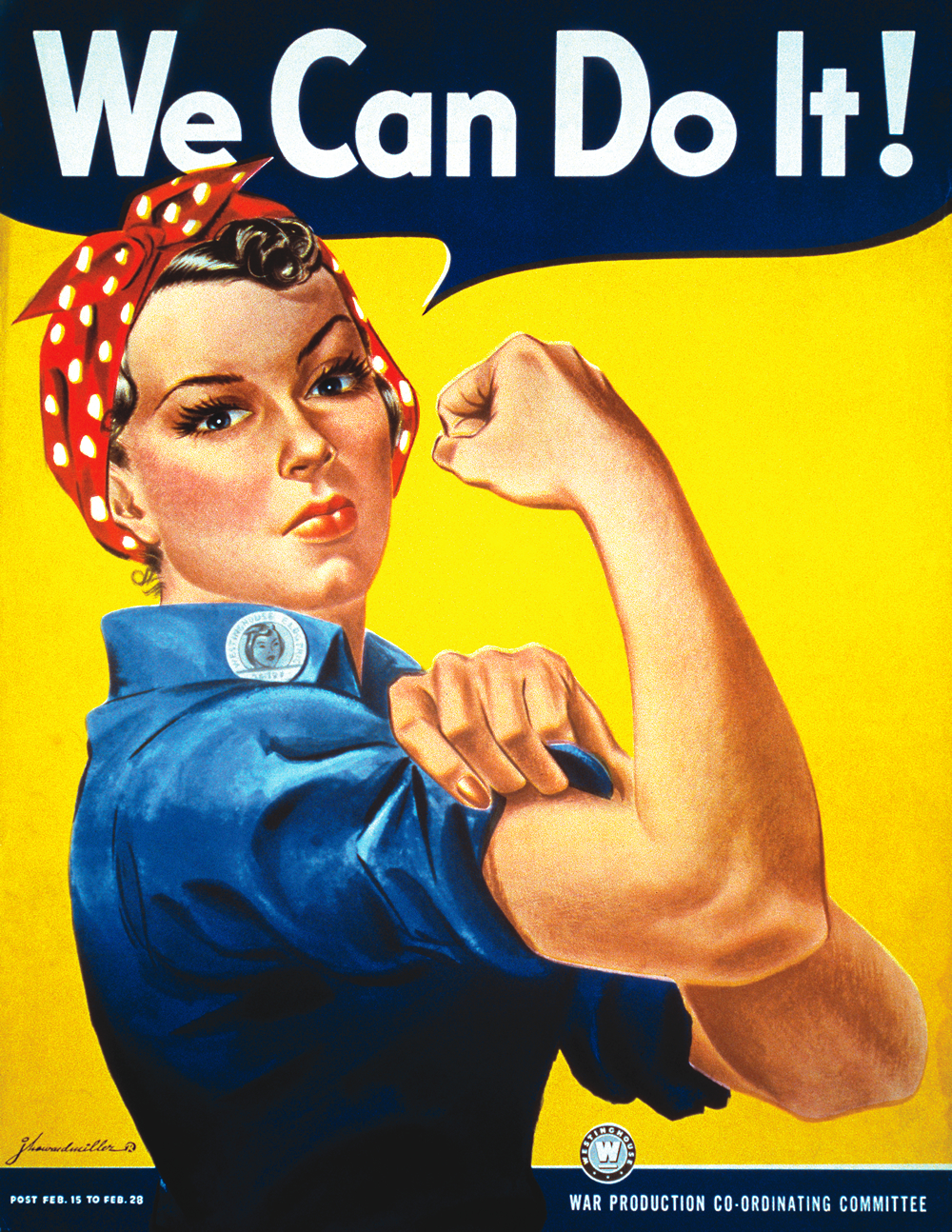
It's also about sex. These photos represent real-life "Rosie the Riveters." This vision of "Rosie the Riveter" on the left below (I know this isn't technically her) has become more iconic than Norman Rockwell's original "Rosie" character on the right. Both depict women transgressing gender norms -- work shirts, muscles, self-assured gazes -- but Rosie on the left retains the trappings of femininity. To rephrase it, she's the (conventionally) hot one. Shiny hair, shiny nails, shiny lips, strong without looking like Popeye. Left-side Rosie's power comes as much from her "traditionally" feminine, sexy physical presense as from her flexed muscle and determined look; Right-side's comes from her rivet gun, massive forearms, and meaty sandwich. Both play on a sense of novelty, even irony, but Rockwell's portrait remains more comfortable with the tough, transgressive realities of women in wartime production.

Here's a selection of some more photos in the collection that represent an amazing spectrum of visions, constructions, and realities of femininity. How do their subjects' appearance and interaction with their environments affect your perceptions?
[WHOA]


Lastly, the caption on this next one captures the enduring sense of novelty surrounding women factory workers in heavy industry: Girl inspector confers with a worker as she makes a a careful check of center wings for C-47 transport planes, Douglas Aircraft Company, Long Beach, Calif.
Plus, check out that body language.