Showing posts with label interpretation. Show all posts

Saturday, July 2, 2011

Back to Tennessee

I've never been to Tennessee. I should probably go though, because I now know two great songs about going back to Tennessee. Whoa, man. Boy do I love having a blog...yeah, this has something to do with industrial history.


Of course, the Grateful Dead: http://www.youtube.com/watch?v=t7oNS-bDZqc

And, from her really, really good and brand new album The Harrow and the Harvest, Gillian Welch: http://www.youtube.com/watch?v=PRA3sQoCluo

This made me wonder what's so great about Tennessee, and then I found this: http://www.bemishistory.org/ Click it! Bemis, Tennessee (Bemis also being, weirdly, the most annoying of my childhood parental nicknames): Where Industry and Friendliness Blend Into Progress. Early 20th century southern cotton mill ideology at its most succinct!

Anyway, after my snotty northern socialist self got over that old-timey corporate line, I got to thinking about the thousands of very local industrial history sites around the country. The website isn't the slickest, but its grassroots community focus, pride, and content is apparent -- an online exhibition, local events, ways to contribute memories, conduct family research, and get involved in preservation. And that's an immediate audience connection that bigger, shinier museums sometimes struggle to capture.


Sunday, June 12, 2011

Un-Industrial

So yesterday I saw Jon Brooks: A Collaboration with Nature at the Currier Museum. Highly recommended...but it closed today. Psych!

It's ok, he has a great website where you can see a lot more of his work, and his unbelievable house!

But this is not (really) just another excuse to blog about art. His pieces range from functional furniture to whimsical new furniture(esque) forms. They interpret natural wood forms and furniture conventions to create something new, organic, and artistic. It struck me while I was in the exhibition that I was seeing, among many things, an antithesis of industrial processes and aesthetics.

It's art, so maybe that's not super surprising; but it's not just that this is handmade furniture, it's that it moves beyond deep conventions, it totally reimagines something -- furniture -- that we're used to seeing in factory-made and/or highly stylized form.

Industrially made utilitarian objects -- like, 99% of the stuff a lot of us interact with -- are standardized, designed to reflect convention, divorced from natural forms and properties, mass-produced. It's a pretty basic observation, but the contrast made an impression and led me to look again at the industrial 99%.

So, taking it one step forward: seeing things in a provocative new way? Bring it to more (industrial) history museums! How rad would it be to see Brooks' stuff in, like, the Grand Rapids Public Museum's Furniture City exhibit (Grand Rapids -- "the first center of mass-produced furniture in North America!") ? Or -- omg -- a historic house.

Compare Jon Brooks' Citron Altar...
Citron Altar, 2007. Jon Brooks.

...With, say, this:

One of my favs from the exhibition:
Tons more on Flikr!

Sunday, May 8, 2011

Free stuff for when you don't have a budget: DIY clip art

Clip art is the worst! It's generic and cheesy. It's not cohesive -- start using it and next thing you know you've got ten images in ten different (cheesy) styles.

I won't go on. If you want to read a longer and more articulate rant against clipart, see Interpretation by Design: Why Clip Art is Evil.

But what's a museum kid to do? Your supervisor want a snappy poster for next month's family program! You don't have a budget! Clip art is free...colorful...tempting. I'll admit, I've done it.

As suggested in the aforementioned Interpretation by Design posting, making your own can be a great alternative. It takes a little more time -- second only to budgets in things you probably don't have...but it's fun, reusable, and in my possibly irrational opinion, totally worth it!

Ok, I'm a pretty terrible artist, but here's how I got my hands on some free, cohesive, non-generic, and pretty cute -- if I may say so -- images for a recent programming publication. Maybe this is obvious...but it took my a while to get it right:

  1. Find some pictures of whatever you want on Google Image Search.
  2. Print them out.
  3. Draw over the important part of the image with a black Sharpie.
  4. Put a blank piece of paper on top and trace your underlying Sharpie lines in pencil. 
  5. Make any alterations and adjustments to your pencil-image.
  6. Retrace over the pencil lines in Sharpie.
  7. Put ony more blank piece of paper on top and trace your underlying Sharpie lines in Sharpie -- this creates a clean, pencil-free copy.
  8. Find a coworker who has a scanner, and scan your clean, 3rd-generation Sharpie images from step 7.
  9. Use 'em! (You can use a really basic free photo editor like MS Office Picture Manager or even...Word...to clean them up. With black and white line images I'd recommend upping the contrast as much as possible and setting the white background as the transparent color before you drop them into your publication.)
Results -- not exactly the work of a professional artiste, but a great alternative for interesting, professional-looking, kid/family-oriented publications:


Sunday, April 17, 2011

Keeping Things

Museums keep things.


And we interpret, preserve, explore, and reimagine them. Today, the New York Times has a nice interactive feature called Belongings, which takes a personal look at the good old question of why we keep the things we do.


"There are three million immigrants in New York City. When they left home, knowing it could be forever, they packed what they could not bear to leave behind: necessities, luxuries, memories. Here is a look at what some of them brought."


Check it out here.

Saturday, April 16, 2011

Putting Visitors to Work

Museum at Work? Why not put visitors to work?

One of my most memorable participatory museum experiences ever was at Mystic Seaport. It's pretty simple, they make a bunch of visitors work together to raise the sails of a 19th century ship. A staff "chanteyman" sings a work song to keep the pace. You're actually standing on the ship, doing it.

The physical novelty of my experience as a visitor served to underscore the extreme historical routine-ness of it. For me, I realized, this was a total break from my normal rhythms; for sailors 150 years ago, it was the most basic, even monotonous rhythm of their lives at sea.

It's an effective interpretive program because it's a relatively simple, immersive, authentic, and cooperative activity. Strangers rely on one another. It's dramatic. The sails are big, and real, and put up a lot of resistance against the rough rope. Mystic's interpretive staff make it clear that you have to take it seriously, too -- everyone on the line has to plant their feet properly, pay attention to the rhythm of the song to know when to pull the rope, and place hand over hand correctly as they pull.

I really didn't want to be the one to mess up. It feels like there's really something at stake. Check it out: in this video they're raising a whale boat (I think), rather than the sail, but the environment, effort, and chantey are similar enough to give an impression:


Can other museums put visitors to work in a similarly safe but powerful way?

Friday, March 25, 2011

Triangle Shirtwaist Factory Fire: March 25, 1911-2011

Today is the 100th anniversary of the Triangle Shirtwaist factory fire. On March 25, 1911, 146 garment workers in New York City were killed in a workplace fire. Infamously, management had locked the factory's exit doors. A wave of safety reform legislation and memorialization followed. For a moment, the dangerous realities that faced some of the nation's most marginalized industrial workers -- young, female, immigrants from Eastern and Southern Europe -- gripped the nation's attention.
Recently brought to my attention: the New York Times has assembled extraordinary coverage of the many facets of the fire: http://cityroom.blogs.nytimes.com/tag/triangle-shirtwaist-factory-fire/?ref=nyregion

Some particular highlights of museum-think interest:
Triangle Fire: Clinging to Scraps of Memories
Triangle Fire: A Frontier in Photojournalism (interactive)
Garment Work in New York 100 Years After the Triangle Fire (video)
In a Tragedy, a Mission to Remember
Remembering the Triangle Fire, 100 Years Later

And, last but not least, from President Obama's resolution marking today's 100th anniversary:
Despite the enormous progress made since the Triangle factory fire, we are still fighting to provide adequate working conditions for all women and men on the job, ensure no person within our borders is exploited for their labor, and uphold collective bargaining as a tool to give workers a seat at the tables of power...As we mark the anniversary of the Triangle Shirtwaist Factory Fire, let us resolve to renew the urgency that tragedy inspired and recommit to our shared responsibility to provide a safe environment for all American workers.

Thursday, March 24, 2011

NYT: Grab a Brew While They Face Death

Grab a Brew While They Face Death
Today, the Times introduces us to "Coal," a new series a la "Deadliest Catch," "Ice Road Truckers," etc. on Spike TV. With less Arctic -- it's about coal. Mining. In West Virginia:


It’s an uneasy modern dynamic. The men on these “documentary-reality” shows sacrifice their bodies and risk their lives doing down and dangerous jobs to try to provide a good life for themselves and their families. But what the producers and viewers want is what they call “good TV” — in this case, working-class fantasies aimed at men craving televised booster shots of testosterone.


Then, mix a little capitalist-class fantasy into that sudsy all-American brew:
  • "People have no idea how important the coal industry is to America," says Mike Crowder, CEO of Cobalt Coal, in a video on Spike's website.
Leave it to Times commenters to bring us back:
  • "Egad! Must be backed by the coal and gas industry? Manly men want to leave the coal in the ground," says Times online commenter Jim S., of Illinois.
Ok, so what's so commercially successful about TV that celebrates/showcases/exploits traditional (read masculine) industry that industrial museum don't got? Besides being accessible from the comforts of one's couch. I don't know, I tragically do not get Spike TV. It feels weird to think about coal mining as escapist entertainment -- but really, is this so different from my own coal-fascination and horror? I've never even been near a coal mine, but I have some sort of idealized/romanticized/escapist/earnest/ironic love of mining songs.


So maybe it's about nostalgia, whether it's Spike nostalgia for a myth of all-American industry, manliness, manual labor, or left-wing New England lady-blogger nostalgia for a myth of old-time authenticity and class struggle. Museums shouldn't trade in nostalgic myths, but the feeling of personal connection contained in them is potentially valuable when harnessed more critically: it comes back to people, our different experiences, the stories we tell, and the values we attach to one another.


Also, TV: Undercover Boss and Secret Millionaire make me want to puke.

Tuesday, March 15, 2011

Welcome to Pine Point

Welcome to Pine Point

Go have a look at this incredible online interactive multimedia mind blowing documentary about the town of Pine Point way up in Canada's Northwest Territories. The mine built it, a community grew, the mine closed, the town was completely razed.

This site is a testament to people and memory and postindustrial spaces totally unlike anything else.

See also:
Museum 2.0: Welcome to Pine Point: A Multimedia Exploration of Nostalgia, History, and What it Means to be Human. Great anaylsis by Nina Simon at Museum 2.0 linking the techniques used and connections made here to the museum experience.


UPDATE: OK, so http://www.nfb.ca/ is my new favorite website. Enjoy documentaries, animations, alternative dramas and interactive productions on the web, on your personalized home page, or on your iPhone. Free for personal use and on a subscription basis for schools and institutions. Where have you been all my life, National Film Board of Canada??? Canadians are so nice!

Monday, March 7, 2011

NPR: Coal Reignites A Mighty Battle Of Labor History

Great story about the 1921 "battle of Blair Mountain," in West Virginia, and current controversy over adding it to the National Register of Historic Places. Preserve the space of a landmark event in US labor and mining history, or open the site to mountaintop removal mining? This story is an unusually direct glimpse into the tensions that often arise between preservation, economic realities, and memory in dealing with local labor heritage and industrial history.
A sign commemorating the battle of Blair Mountain in Logan County, W.Va. NPR.
Key points:
King believes this is hallowed ground, like Gettysburg or the Edmund Pettus Bridge in Selma, Ala., places where America's history was forever changed. But he's had a hard time making that case to the folks in Logan County — a place where every fourth person is out of work.
There are only about 16,000 miners in West Virginia today. Mountaintop removal doesn't require as much manpower as underground mining. These are coveted jobs; they pay well. So for the most part, miners are more interested in seeing the economy grow than preserving what they see as just another mountain.


"This is a political fight, this is a social fight, this is a fight about our history, our heritage, our culture," Simmons says. "It's a fight about what kind of society West Virginia is going to be going forward and what has been in its past."
Sounds to me like labor heritage interpretation at its best, and most relevant.

American Experience: Triangle Fire

Highly recommended! American Experience: Triangle Fire. PBS is currently streaming the entire hour-long documentrary online:  http://www.pbs.org/wgbh/americanexperience/films/triangle/player/

The film focuses not only on the fire itself, but on the extraordinary struggle to unionize female garment workers in the year that led up to the tragedy. One point made in the film stuck out, so much so that I wrote it down. In going out on strike to fight for improved working conditions and wages, thousands of these women "walked away from the only thing between their families and starvation" -- their dangerous, low-paid jobs.

That's what I call interpretation! A simply, evocatively made point that applies not only to this particular series of events, but that gets at the essence of Progressive Era labor struggles. Whether in New York, Lawrence, Paterson, etc., a powerful mixture of community, conviction, and desperation drove workers in this country's burgeoning industrial centers to take enormous personal risks for a chance at something better.

Tuesday, February 15, 2011

NYT: Art and the Triangle Shirtwaist Fire

Today in the New York Times: In Art, Recalling a Century Old-Tragedy

As the March 25 centennial of the Triangle Shirtwaist approaches, artist and film maker Anthony Giacchino is using art to visualize and commemorate the 146 victims of the 1911 factory fire in an unconventional, directly engaged way:

"I just kept thinking about the number 146,” he said. “I would put names in front of the buildings, but it still did not give me a sense of it. Why not send letters? They’d probably come back. Then I’d be able to see what 146 looks like.”

Helped by Scott Frawley, a student at Fordham University, he compiled a list of addresses and wrote them on envelopes; for six unknown victims, he simply wrote “Unidentified Fire Victim.” Inside each was a short message — in case the address still existed and the current occupant opened the envelope — asking people to reflect on the tragedy, as well as a poem written by Morris Rosenfeld days after the fire.

Mr. Giacchino warned his letter carrier to expect a deluge of returned letters. So far, 130 have come back.

Monday, January 24, 2011

Mining, and Other Scary Industries: Fun for the Whole Family...?

Fun for the Whole Family: Welcome to the Black Hills Mining Museum, located in the mile-high city of Lead.
*** 
 Underground Exhibit
Our newest major exhibit opened in 2002. This re-creation of a big part of a miner's life will leave you smiling — and shaking your head in amazement! [World Mining Museum]

***

Welcome!
Join us for an unforgettable experience as we travel underground to explore the world’s oldest continuously operated anthracite coal mine! [No. 9 Coal Mine & Museum]

Do industrial museums have to have something inspiring, uplifting, or "entertaining" for their visitors?
A quick Monday morning Googling of "mining museum" revealed the above phrases from museum websites.

I have this thing where I get really bummed out when I think about coal mining. Maybe it's because I'm so completely removed in every way from the actual experience that it gives me the creeps -- the working conditions, psychological impact, corporate stuff, environmental impact, danger, health hazards, etc. I know that for plenty of people past and present it's just part of life, they deal.

Anyway: fun, exclamation points, unforgettable, amazement. These museums really want you to visit...and due to their subject matter probably aren't on every family's vacation itinerary. But the tone feels off. I'm picking on mines, but can industrial museums of all kinds connect to visitors emotionally without the "fun!!," while leaving them curious, empathetic, and active...rather than super depressed?

Check out the LOC's Lewis Hine Child Labor Committee Collection, subject heading coal miners. I find these to be some of the toughest historical photos ever taken to look at, and look in the eye.


Trapper Boy, Turkey Knob Mine, Macdonald, W. Va. Boy had to stoop on account of low roof, photo taken more than a mile inside the mine. Witness E. N. Clopper. Location: MacDonald, West Virginia. Lewis Hine, 1908.

Friday, January 14, 2011

Art - Memory - Place

We're coming into an era of serious labor history centennials. 2011 is the centennial of the Triangle Shirtwaist Factory Fire, and the Grey Art Gallery at good old NYU just opened a really thoughtful looking exhibit dealing with the event through a somewhat unconventional mix of perspectives and media.
Art - Memory - Place: Commemorating the Triangle Shirtwaist Factory Fire (Great website.)

Part I deals with the history of the fire itself, its human impact, and the immediate social aftermath. Part II takes us into mid-20th century reforms in workplace safety as an act of memorialization. (I am excited about the apparent abundance of 1930s mural art here.) Parts III and IV deal with the fire's 50th anniversary, and its enduring legacies in labor activism, memory, and large-scale tragedy today.

Historic photos! Artifacts! Artwork! Activism! Documenting! Interpreting! Memorializing!

Making a resolution to see this before it closes March 26, the day after the tragedy's 100th anniversary.
Detail of mural by Ernest Fiene, History of the Needlecraft Industry (1938-1940)

Tuesday, January 4, 2011

LABOR ARTS

How am I just learning about this website now? From the Rober Wagner Labor Archives at NYU (my own alma mater! Again, how did I not know about this...), and several other partners, LABOR ARTS is:

"a virtual museum; we gather, identify and display images of the cultural artifacts of working people and their organizations. Our mission is to present powerful images that help us understand the past and present lives of working people. AFL-CIO President John J. Sweeney has urged all international unions to cooperate in locating for display on Labor Arts 'the treasure trove of cultural objects that have moved workers into action from the very inception of our movement.'"

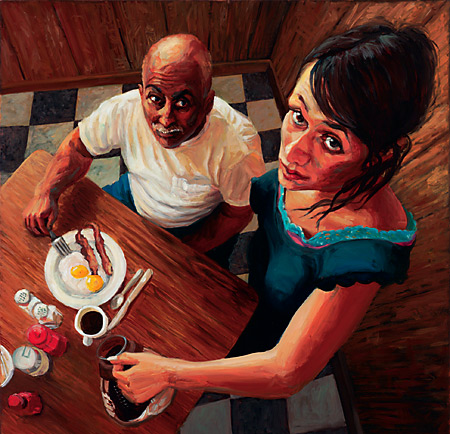
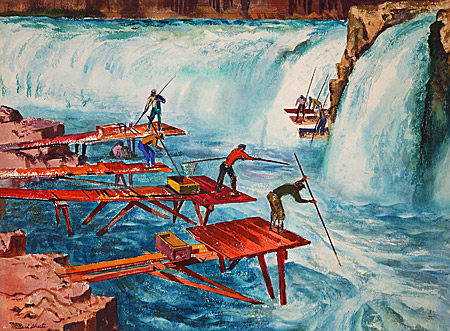
So far -- and have only scratched the surface of this resource -- loving the Scenes of American Labor exhibit:
Taos Diner, Jack R. Smith, 2005

Indians Fishing Cielilo Falls - Columbia River, Millard Sheets, 1950

It's a way cool site with an incredible variety of media. Check it out!

Sunday, December 12, 2010

Women @ Work

More amazing color photos from the Library of Congress. From the Farm Security Administration/Office of War Information collection, photographs of women at work in war industries during WWII.

First of all, Mrs. Eloise Ellis here is awesome.
Mrs. Eloise J. Ellis has been appointed by civil service to be senior supervisor in the Assembly and Repairs Department at the Naval Air Base, Corpus Christi, Texas. She buoys up feminine morale in her department by arranging suitable living conditions for out-of-state employees and by helping them with their personal problems. Library of Congress.
Second, these photos are fascinating from both an aesthetic, historical, and sociological point of view. There's a strong sense of novelty here in the way that photographers depicted female factory workers. An admiring but distinctly ironic tone pervades the captions. The significant historical moment and the still-powerful visual novelty of seeing women in an industrial environment remains appealing; I, for one, am blown away by the above photo. But the collection is (fascinatingly) problematic. These are women, the viewer is constantly reminded, and their role as heavy industrial workers is a temporary, novel, even unnatural -- albeit patriotic -- state of affairs.

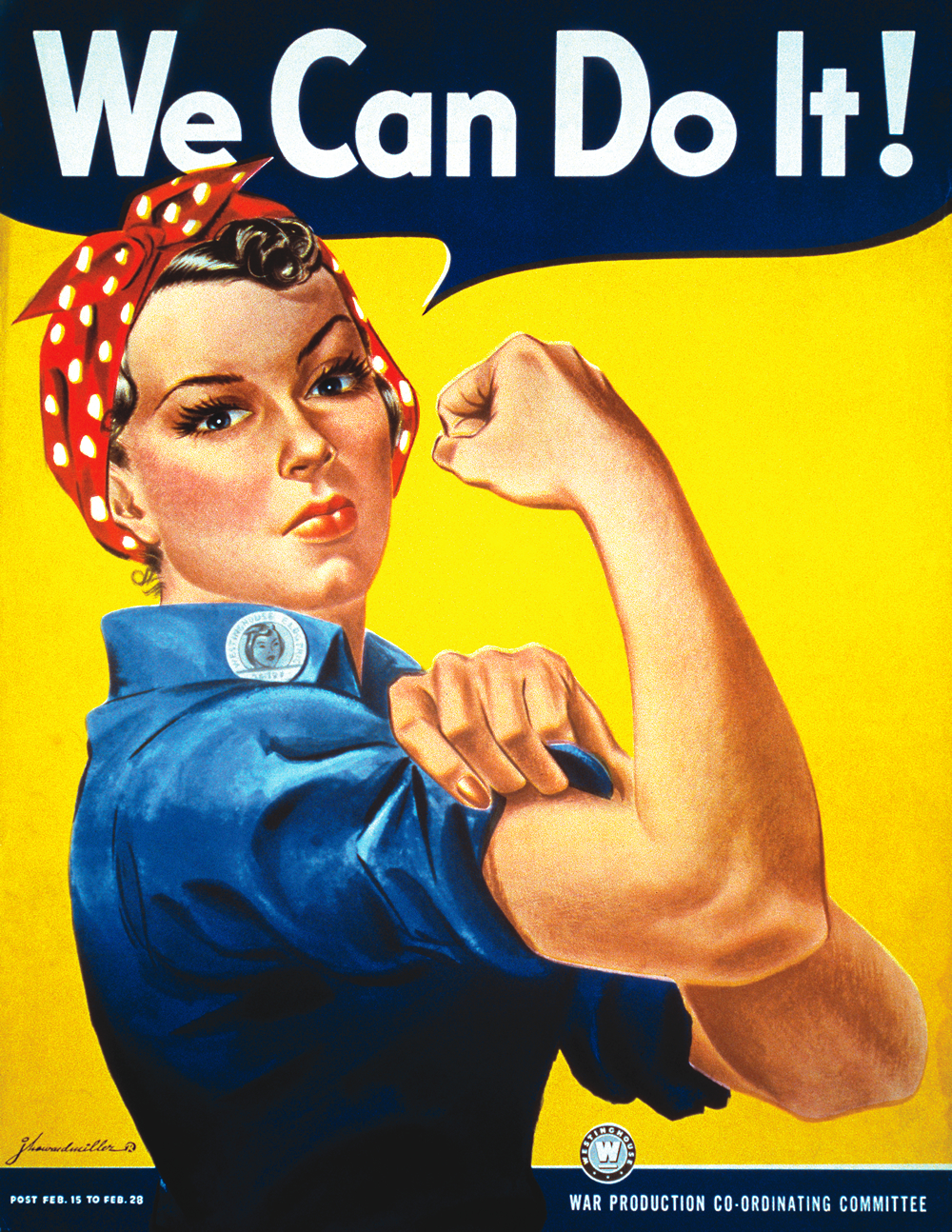
It's also about sex. These photos represent real-life "Rosie the Riveters." This vision of "Rosie the Riveter" on the left below (I know this isn't technically her) has become more iconic than Norman Rockwell's original "Rosie" character on the right. Both depict women transgressing gender norms -- work shirts, muscles, self-assured gazes -- but Rosie on the left retains the trappings of femininity. To rephrase it, she's the (conventionally) hot one. Shiny hair, shiny nails, shiny lips, strong without looking like Popeye. Left-side Rosie's power comes as much from her "traditionally" feminine, sexy physical presense as from her flexed muscle and determined look; Right-side's comes from her rivet gun, massive forearms, and meaty sandwich. Both play on a sense of novelty, even irony, but Rockwell's portrait remains more comfortable with the tough, transgressive realities of women in wartime production.

Here's a selection of some more photos in the collection that represent an amazing spectrum of visions, constructions, and realities of femininity. How do their subjects' appearance and interaction with their environments affect your perceptions?
[WHOA]


Lastly, the caption on this next one captures the enduring sense of novelty surrounding women factory workers in heavy industry: Girl inspector confers with a worker as she makes a a careful check of center wings for C-47 transport planes, Douglas Aircraft Company, Long Beach, Calif.
Plus, check out that body language.

Tuesday, November 30, 2010

Industriemuseum!

Really interesting post a couple days ago on The Uncataloged Museum about industrial heritage development in Europe: From Cotton to Culture: Changing the Face and Future of European Cities.

In said post I learned there's this amazing thing called the European Route of Industrial Heritage, a partnership among EU member states, industrial heritage museums, and academic institutions. The idea is to promote tourism that links diverse industrial sites by theme or region. Do the mining tour of Europe! Backpacks, anyone?

Seriously, I think this is a pretty exciting way to push industrial history toward greater relevance for visitors -- the ERIH situates what can often feel like very local history in an interconnected network of regional and international sites. If visitors (most of whom are probably nerds, obviously unlike myself...) are accessing these resources, there's potential here for engaging people with the interrelated historical experiences of work, and a deeper understanding of how the industrial past shapes the present.

Also, check out the photo gallery. These museums look like they run the gamut from traditional interpretive displays to huge, raw, tour-able factory sites.

Kinder im Museum. Also ein interessanter Museumsbesuch für "groß und klein"und nicht nur für Fachleute! Industriemuseum Brandenburg an der Havel.

The museum looks like it's basically a huge, partially operable steel mill. I love that these kids get to just hang out with rusty gears and apparently still-fiery blast furnaces. Hardhats!

Industriemuseum Brandenburg and der Havel.