Showing posts with label art. Show all posts

Saturday, August 13, 2011

Back on Track in Richmond with...Mocha Dick and Confederate Industrial Ruins

Ok, getting Museum at Work back on track from de facto summer hiatus. After about a million different plans for first week of August, I ended up visiting my charming brother in DC, who was accommodating and delighftul enough to drive me all the way to Richmond to see this fantastic, totally rad installation at the Virginia Museum of Fine Arts. Presenting...Tristan Lowe's Mocha Dick:

Tristin Lowe’s colossal sculpture Mocha Dick is a fifty-two-feet-long recreation of the real-life albino sperm whale that terrorized early 19th-century whaling vessels near Mocha Island in the South Pacific. Mocha Dick, described in appearance as “white as wool,” engaged in battle with numerous whaling expeditions and inspired Herman Melville’s epic Moby-Dick (1851). Lowe worked with the Fabric Workshop and Museum in Philadelphia to make the sculpture: a large-scale vinyl inflatable understructure sheathed in white industrial felt.


 Unbelievable. Naturally, I HAD TO GO. IT WAS SUPER WORTH IT.

I think this is a brilliant and effective museum touch:


Next up, the National Park Service Civil War Visitor Center at the site of the Tredegar Iron Works. In search of my National Park Passport stamp, I admit that I had no idea we were stumbling into the remains of the Confederacy's main iron works. Pretty creepy. I also admit that we skipped the private museum, had a lovely chat with an NPS volunteer, and then poked around the industrial remains. In addition to a partially intact waterpower system, most of the remaining infrastructure was post-Civil War era manufacturing equipment, and the Park Service has displayed a number of turbine pieces outside so visitors can explore the 19th century technology up close and personal, including:

  • touching
  • smelling
  • peering
  • taking stupid pictures
  • climbing
  • "whoa"-ing
All of which provided this loudmouth anti-Confederate Northerner an opportunity to make some interesting intellectual and emotional connections with this unusual site. And take a couple dumb pictures. 
My brother could have made some good connections too if he hadn't had to say, "Em, the park rangers are going to yell at us" every fifteen seconds. That no-touch stigma is hard to shake.

Sunday, June 12, 2011

The Workers: MASS MoCA, I love you.

Dear MASS MoCA,

I have been trying to write this blog entry for two months, struggling to find the right words to say it. It's simple, really: I love you. We are like, totally soul mates. It's ok, I know you have lots of other visitor-soulmates; in fact, I think an open relationship is the best kind of relationship a museum and its visitors can have.

I've known it for a long time. But just when I thought you were practically perfect, this BLOWS MY MIND. And my little heart. A new exhibition: The Workers, May 29, 2011-March 25, 2012.

Ok, from MASS MoCA:

We all know what Rosie the Riveter looked like, and what she stood for. [Oh boy, do we!]

Ford-era production line labor -- and the rise of powerful unions -- left us indelible portraits of work in mid 20th century America. [Don't make me swoon!]...

But what does work look like today in a global economy marked by outsourcing, rapid migration, disruptive economies, and a state of labor that seems fractured, precarious, and almost invisible? With video, sculpture, photography, and performance art from 25 artists, this exhibition examines the way labor is represented today (and how some contemporary workers choose to represent themselves. [Emphasis mine.]

The timing, and the place, could not be more fitting: Once the site of a bustling factory itself -- whose closure in the face of intense international competition left nearly a third of it's community out of work -- MASS MoCA is perhaps uniquely positioned to present this timely show... [Yes! YES!]

And as if all that wasn't enough:

In conjunction with The Workers MASS MoCA curator Susan Cross has invited Bureau for Open Culture -- a nomadic contemporary arts program directed by curator and art historian James Voorhies -- to inhabit one of the museum's buildings for the first four months of the exhibition. Set within a previously unused industrial building on the grounds of MASS MoCA, Bureau for Open Culture presents I Am Searching for Field Character, an exhibition series of public conversations, performances, installations, and workshops with a slew of visiting artists, writers, designers, and thinkers, a well as a beer garden which operates every Thursday and Friday night between May 26 and September 30.

Let me get this straight: CONTEMPORARY ART AND LABOR, HISTORIC INDUSTRIAL SPACES, NOMADIC ARTS PROGRAMS, SUPER-RELEVANCE, AND A...BEER GARDEN??? And then there's the BOC project publication: Bureau for Open Culture: On Symptoms of Cultural Industry. [Preview: WHY is it we are so moved by decaying environments? What propels the creative and cultural, the spontaneous and unpredictable in response to the dilapidation, vacancy, poverty and hardship of crumbling capital? Oh. My.]

I could not possibly make up anything dreamier. Ok, so I'll try not to get too excited before I've experienced it all.

No, I think I'll just got with it.

WHEEEEEEEEEEEEEEEEEEEEEEEEEEE!

Un-Industrial

So yesterday I saw Jon Brooks: A Collaboration with Nature at the Currier Museum. Highly recommended...but it closed today. Psych!

It's ok, he has a great website where you can see a lot more of his work, and his unbelievable house!

But this is not (really) just another excuse to blog about art. His pieces range from functional furniture to whimsical new furniture(esque) forms. They interpret natural wood forms and furniture conventions to create something new, organic, and artistic. It struck me while I was in the exhibition that I was seeing, among many things, an antithesis of industrial processes and aesthetics.

It's art, so maybe that's not super surprising; but it's not just that this is handmade furniture, it's that it moves beyond deep conventions, it totally reimagines something -- furniture -- that we're used to seeing in factory-made and/or highly stylized form.

Industrially made utilitarian objects -- like, 99% of the stuff a lot of us interact with -- are standardized, designed to reflect convention, divorced from natural forms and properties, mass-produced. It's a pretty basic observation, but the contrast made an impression and led me to look again at the industrial 99%.

So, taking it one step forward: seeing things in a provocative new way? Bring it to more (industrial) history museums! How rad would it be to see Brooks' stuff in, like, the Grand Rapids Public Museum's Furniture City exhibit (Grand Rapids -- "the first center of mass-produced furniture in North America!") ? Or -- omg -- a historic house.

Compare Jon Brooks' Citron Altar...
Citron Altar, 2007. Jon Brooks.

...With, say, this:

One of my favs from the exhibition:
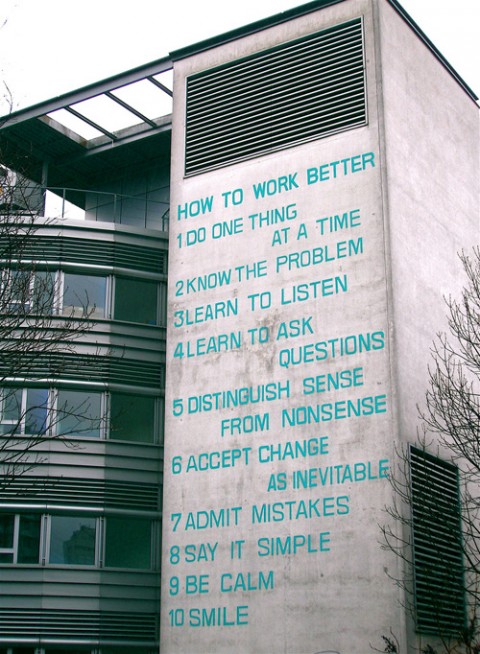
Tons more on Flikr!

Wednesday, June 1, 2011

Museum for Obeast Conservation Studies


Artist Rachel Herrick's "Museum for Obeast Conservation Studies" is a pretty unique contemporary art endeavor. It has nothing to do with industrial history, but puts a sharp lens on museums, among other things, and I feel like blogging about it.

From her website, "MOCS and my work with North American Obeasts satirize the social stigma around fatness through the legitimizing tropes of science."

I won't explain it much more than that...just go check out the website: http://www.obeasts.org/.Working alongside the unique satirizing of social stigma, the work is a smart, surreal reflection of the formal power of (slick, modern) museum convention and conservation narratives. The website is pretty uncanny...sharp, unsettling, clever, museum-y.

Physical exhibition on view at the Maine College of Art! "MOCS @ICA Portland," advertises the MOCS website. "Dang, this looks interesting, they must mean Portland, Oregon," I thought. Imagine my pleasant surprise when it turned out to be Maine! Exhibition closes June 12; as soon as my decrepit car gets fixed I'm schlepping up to Portland. Updates to follow.

Sunday, May 8, 2011

Free stuff for when you don't have a budget: DIY clip art

Clip art is the worst! It's generic and cheesy. It's not cohesive -- start using it and next thing you know you've got ten images in ten different (cheesy) styles.

I won't go on. If you want to read a longer and more articulate rant against clipart, see Interpretation by Design: Why Clip Art is Evil.

But what's a museum kid to do? Your supervisor want a snappy poster for next month's family program! You don't have a budget! Clip art is free...colorful...tempting. I'll admit, I've done it.

As suggested in the aforementioned Interpretation by Design posting, making your own can be a great alternative. It takes a little more time -- second only to budgets in things you probably don't have...but it's fun, reusable, and in my possibly irrational opinion, totally worth it!

Ok, I'm a pretty terrible artist, but here's how I got my hands on some free, cohesive, non-generic, and pretty cute -- if I may say so -- images for a recent programming publication. Maybe this is obvious...but it took my a while to get it right:

  1. Find some pictures of whatever you want on Google Image Search.
  2. Print them out.
  3. Draw over the important part of the image with a black Sharpie.
  4. Put a blank piece of paper on top and trace your underlying Sharpie lines in pencil. 
  5. Make any alterations and adjustments to your pencil-image.
  6. Retrace over the pencil lines in Sharpie.
  7. Put ony more blank piece of paper on top and trace your underlying Sharpie lines in Sharpie -- this creates a clean, pencil-free copy.
  8. Find a coworker who has a scanner, and scan your clean, 3rd-generation Sharpie images from step 7.
  9. Use 'em! (You can use a really basic free photo editor like MS Office Picture Manager or even...Word...to clean them up. With black and white line images I'd recommend upping the contrast as much as possible and setting the white background as the transparent color before you drop them into your publication.)
Results -- not exactly the work of a professional artiste, but a great alternative for interesting, professional-looking, kid/family-oriented publications:


Saturday, April 23, 2011

Link: The "Dot Room" Video

And now, a brief interlude for something delightful on a Saturday morning. I think this video perfectly encapsulates a peak museum experience:
http://www.flickr.com/photos/sanhelsington/4176481018/

I'm not usually much for cute vids, but...this is super cute. So there.

[By way of Hyperallergic.]

Tuesday, March 8, 2011

King Philip IV...Live!

And now, from the world of non-industrial museum news... Check it out:
http://www.youtube.com/watch?v=TvBbVA36y1U&feature=player_embedded&safety_mode=true&persist_safety_mode=1

From Improv Everywhere: For our latest mission we staged an unauthorized autograph signing in the Metropolitan Museum of Art with an actor who bears a striking resemblance to King Philip IV of Spain. Standing in front of the 400-year-old Velázquez painting, the "King" greeted museum patrons and offered free signed 8x10 photos.

The Met, not surprisingly, put a stop to this rather quickly. I think this is a rad, irreverent in-gallery experience that the Met should be begging these guys to do more often.
gothamist.com

Tuesday, February 15, 2011

NYT: Art and the Triangle Shirtwaist Fire

Today in the New York Times: In Art, Recalling a Century Old-Tragedy

As the March 25 centennial of the Triangle Shirtwaist approaches, artist and film maker Anthony Giacchino is using art to visualize and commemorate the 146 victims of the 1911 factory fire in an unconventional, directly engaged way:

"I just kept thinking about the number 146,” he said. “I would put names in front of the buildings, but it still did not give me a sense of it. Why not send letters? They’d probably come back. Then I’d be able to see what 146 looks like.”

Helped by Scott Frawley, a student at Fordham University, he compiled a list of addresses and wrote them on envelopes; for six unknown victims, he simply wrote “Unidentified Fire Victim.” Inside each was a short message — in case the address still existed and the current occupant opened the envelope — asking people to reflect on the tragedy, as well as a poem written by Morris Rosenfeld days after the fire.

Mr. Giacchino warned his letter carrier to expect a deluge of returned letters. So far, 130 have come back.

Friday, January 14, 2011

Art - Memory - Place

We're coming into an era of serious labor history centennials. 2011 is the centennial of the Triangle Shirtwaist Factory Fire, and the Grey Art Gallery at good old NYU just opened a really thoughtful looking exhibit dealing with the event through a somewhat unconventional mix of perspectives and media.
Art - Memory - Place: Commemorating the Triangle Shirtwaist Factory Fire (Great website.)

Part I deals with the history of the fire itself, its human impact, and the immediate social aftermath. Part II takes us into mid-20th century reforms in workplace safety as an act of memorialization. (I am excited about the apparent abundance of 1930s mural art here.) Parts III and IV deal with the fire's 50th anniversary, and its enduring legacies in labor activism, memory, and large-scale tragedy today.

Historic photos! Artifacts! Artwork! Activism! Documenting! Interpreting! Memorializing!

Making a resolution to see this before it closes March 26, the day after the tragedy's 100th anniversary.
Detail of mural by Ernest Fiene, History of the Needlecraft Industry (1938-1940)

Thursday, January 6, 2011

Devastation from Above

Check it out: striking, gorgeous, horrifying aerial photographs from J. Henry Fair documenting contemporary industrial impact on the landscape. I could see these as a temporary exhibit in just about any good industrial history museum, looking at the ongoing environmental effects of industrialization in a unique way.

Worth looking through the whole set: Devastation from Above

UPDATE: The New York Times has more today. http://www.nytimes.com/2011/01/14/arts/design/14earth.html

Bauxite Waste, J. Henry Fair.

Tuesday, January 4, 2011

LABOR ARTS

How am I just learning about this website now? From the Rober Wagner Labor Archives at NYU (my own alma mater! Again, how did I not know about this...), and several other partners, LABOR ARTS is:

"a virtual museum; we gather, identify and display images of the cultural artifacts of working people and their organizations. Our mission is to present powerful images that help us understand the past and present lives of working people. AFL-CIO President John J. Sweeney has urged all international unions to cooperate in locating for display on Labor Arts 'the treasure trove of cultural objects that have moved workers into action from the very inception of our movement.'"

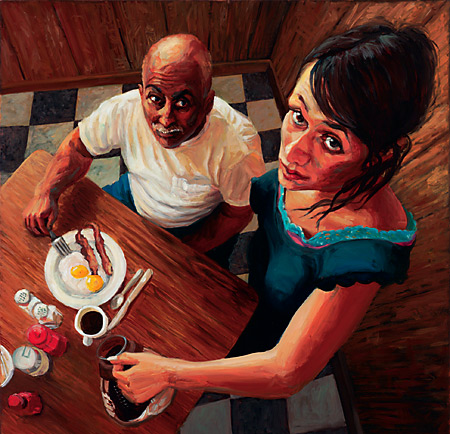
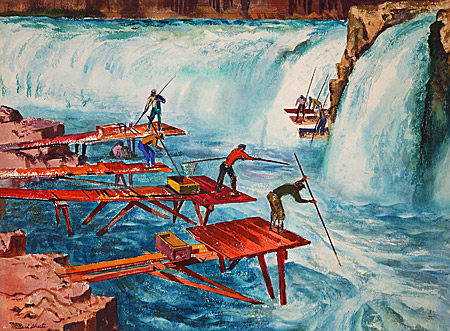
So far -- and have only scratched the surface of this resource -- loving the Scenes of American Labor exhibit:
Taos Diner, Jack R. Smith, 2005

Indians Fishing Cielilo Falls - Columbia River, Millard Sheets, 1950

It's a way cool site with an incredible variety of media. Check it out!

Friday, December 3, 2010

Friday Fun

Even I can't really connect this one to industrial history...But I like it!

http://www.aronsommer.ch/