Friday, January 14, 2011

Art - Memory - Place

We're coming into an era of serious labor history centennials. 2011 is the centennial of the Triangle Shirtwaist Factory Fire, and the Grey Art Gallery at good old NYU just opened a really thoughtful looking exhibit dealing with the event through a somewhat unconventional mix of perspectives and media.
Art - Memory - Place: Commemorating the Triangle Shirtwaist Factory Fire (Great website.)

Part I deals with the history of the fire itself, its human impact, and the immediate social aftermath. Part II takes us into mid-20th century reforms in workplace safety as an act of memorialization. (I am excited about the apparent abundance of 1930s mural art here.) Parts III and IV deal with the fire's 50th anniversary, and its enduring legacies in labor activism, memory, and large-scale tragedy today.

Historic photos! Artifacts! Artwork! Activism! Documenting! Interpreting! Memorializing!

Making a resolution to see this before it closes March 26, the day after the tragedy's 100th anniversary.
Detail of mural by Ernest Fiene, History of the Needlecraft Industry (1938-1940)

Tuesday, January 11, 2011

Reposted -- "Big Tipper: 1910"

Very cool image from Shorpy today: http://www.shorpy.com/node/9682?size=_original

"Toledo, Ohio, circa 1910. "Brown hoist, Ohio Central coal dock." 8x10 inch dry plate glass negative, Detroit Publishing Company."

Thursday, January 6, 2011

Devastation from Above

Check it out: striking, gorgeous, horrifying aerial photographs from J. Henry Fair documenting contemporary industrial impact on the landscape. I could see these as a temporary exhibit in just about any good industrial history museum, looking at the ongoing environmental effects of industrialization in a unique way.

Worth looking through the whole set: Devastation from Above

UPDATE: The New York Times has more today. http://www.nytimes.com/2011/01/14/arts/design/14earth.html

Bauxite Waste, J. Henry Fair.

Tuesday, January 4, 2011

LABOR ARTS

How am I just learning about this website now? From the Rober Wagner Labor Archives at NYU (my own alma mater! Again, how did I not know about this...), and several other partners, LABOR ARTS is:

"a virtual museum; we gather, identify and display images of the cultural artifacts of working people and their organizations. Our mission is to present powerful images that help us understand the past and present lives of working people. AFL-CIO President John J. Sweeney has urged all international unions to cooperate in locating for display on Labor Arts 'the treasure trove of cultural objects that have moved workers into action from the very inception of our movement.'"

So far -- and have only scratched the surface of this resource -- loving the Scenes of American Labor exhibit:
Taos Diner, Jack R. Smith, 2005

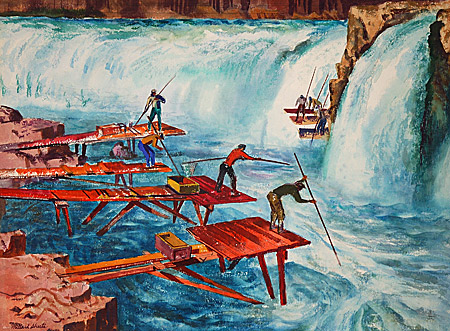
Indians Fishing Cielilo Falls - Columbia River, Millard Sheets, 1950

It's a way cool site with an incredible variety of media. Check it out!

“If they want to strike, they should be fired.”

Call out the Pinkerton guards! The new governor John Kasich of Ohio on public employees, sounding like an incredulous early 20 century steel baron: "If they want to strike, they should be fired,” Mr. Kasich said in a speech. “They’ve got good jobs, they’ve got high pay, they get good benefits, a great retirement. What are they striking for?”

Saw this disheartening (to me) item in the New York Times this morning: Strained States Turning to Laws to Curb Labor Unions. Later found myself talking to a coworker about the difficulties of interpreting the history of organized labor. The incredible decline in union representation over the last half-century and an apparently increasing, politicized (although not historically unprecedented) suspicion of organized labor can make both radical and mainstream labor movements of the past 100 years seem too irrelevant, controversial, anomalous, or difficult to fully integrate into many museums' narratives of American industry.

As the modern structure of work and industry undergoes immense global shifts, maybe the history of organized labor's struggles, values, failures, and achievements is more important than ever. What does the past look like, and why is the present different? A couple organizations that are keeping real conversations alive about the past, present, and future of organized labor in the US:

Tamiment Labor Library at New York University
Labor Heritage Foundation
1912 Lawrence Textile Strike Centennial

Oh, and one more low point from the article -- the new governor of Wisconsin, Scott Walker: "We can no longer live in a society where the public employees are the haves and taxpayers who foot the bills are the have-nots."

That's a ridiculously misleading dichotomy. Divide and conquer. The idea that public employees are the "haves" of our corporate society is, in my estimation, ludicrous.

Monday, December 13, 2010

Monday's feel-good links

Prisoners are America's Strongest Union [Gawker]

And, the original story from the NYT:
http://www.nytimes.com/2010/12/13/us/13prison.html?_r=1&ref=us

"Inmates in at least seven Georgia prisons have used contraband cellphones to coordinate a nonviolent strike this weekend, saying they want better living conditions and to be paid for work they do in the prisons."


Is it wrong to find this sort of inspirational?

Sunday, December 12, 2010

Women @ Work

More amazing color photos from the Library of Congress. From the Farm Security Administration/Office of War Information collection, photographs of women at work in war industries during WWII.

First of all, Mrs. Eloise Ellis here is awesome.
Mrs. Eloise J. Ellis has been appointed by civil service to be senior supervisor in the Assembly and Repairs Department at the Naval Air Base, Corpus Christi, Texas. She buoys up feminine morale in her department by arranging suitable living conditions for out-of-state employees and by helping them with their personal problems. Library of Congress.
Second, these photos are fascinating from both an aesthetic, historical, and sociological point of view. There's a strong sense of novelty here in the way that photographers depicted female factory workers. An admiring but distinctly ironic tone pervades the captions. The significant historical moment and the still-powerful visual novelty of seeing women in an industrial environment remains appealing; I, for one, am blown away by the above photo. But the collection is (fascinatingly) problematic. These are women, the viewer is constantly reminded, and their role as heavy industrial workers is a temporary, novel, even unnatural -- albeit patriotic -- state of affairs.

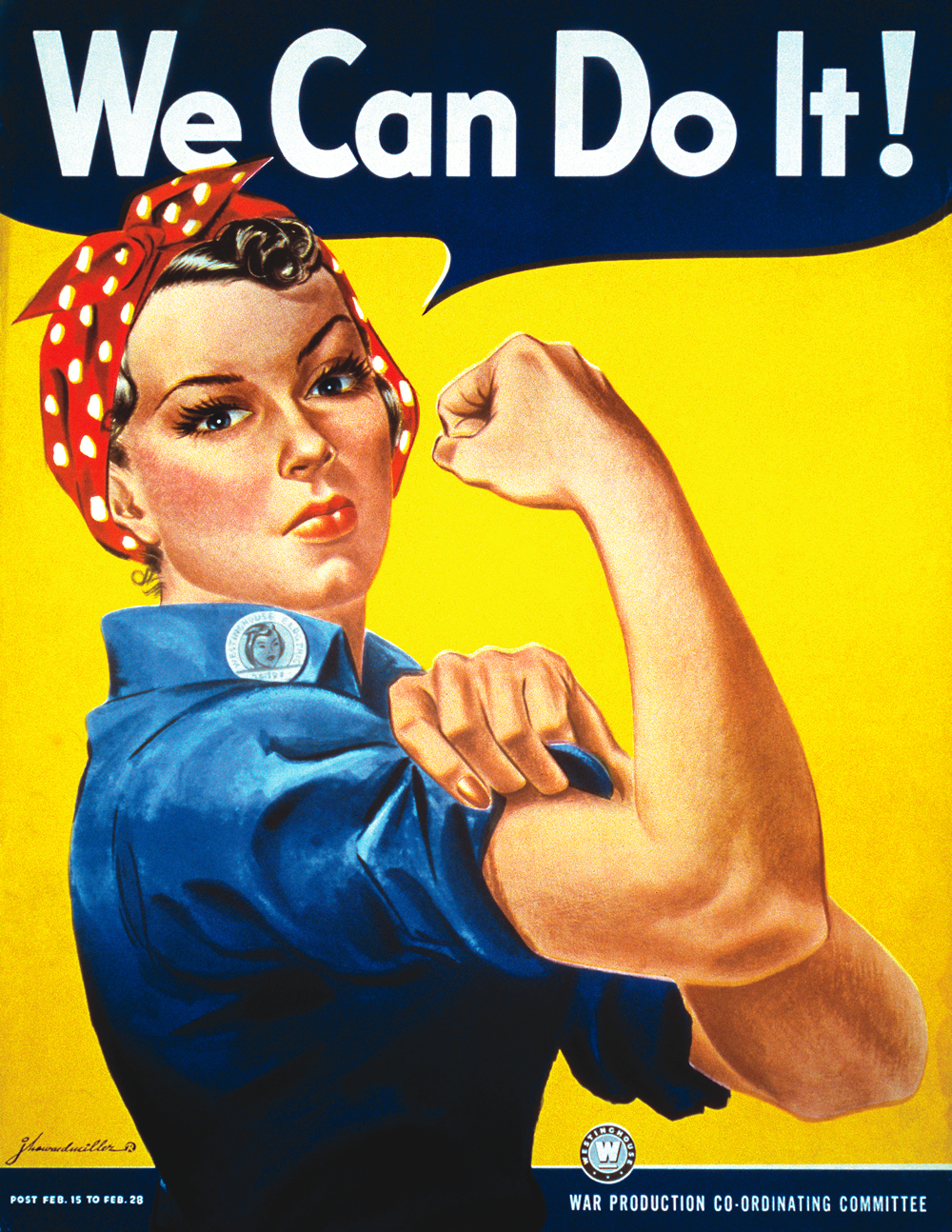
It's also about sex. These photos represent real-life "Rosie the Riveters." This vision of "Rosie the Riveter" on the left below (I know this isn't technically her) has become more iconic than Norman Rockwell's original "Rosie" character on the right. Both depict women transgressing gender norms -- work shirts, muscles, self-assured gazes -- but Rosie on the left retains the trappings of femininity. To rephrase it, she's the (conventionally) hot one. Shiny hair, shiny nails, shiny lips, strong without looking like Popeye. Left-side Rosie's power comes as much from her "traditionally" feminine, sexy physical presense as from her flexed muscle and determined look; Right-side's comes from her rivet gun, massive forearms, and meaty sandwich. Both play on a sense of novelty, even irony, but Rockwell's portrait remains more comfortable with the tough, transgressive realities of women in wartime production.

Here's a selection of some more photos in the collection that represent an amazing spectrum of visions, constructions, and realities of femininity. How do their subjects' appearance and interaction with their environments affect your perceptions?
[WHOA]


Lastly, the caption on this next one captures the enduring sense of novelty surrounding women factory workers in heavy industry: Girl inspector confers with a worker as she makes a a careful check of center wings for C-47 transport planes, Douglas Aircraft Company, Long Beach, Calif.
Plus, check out that body language.